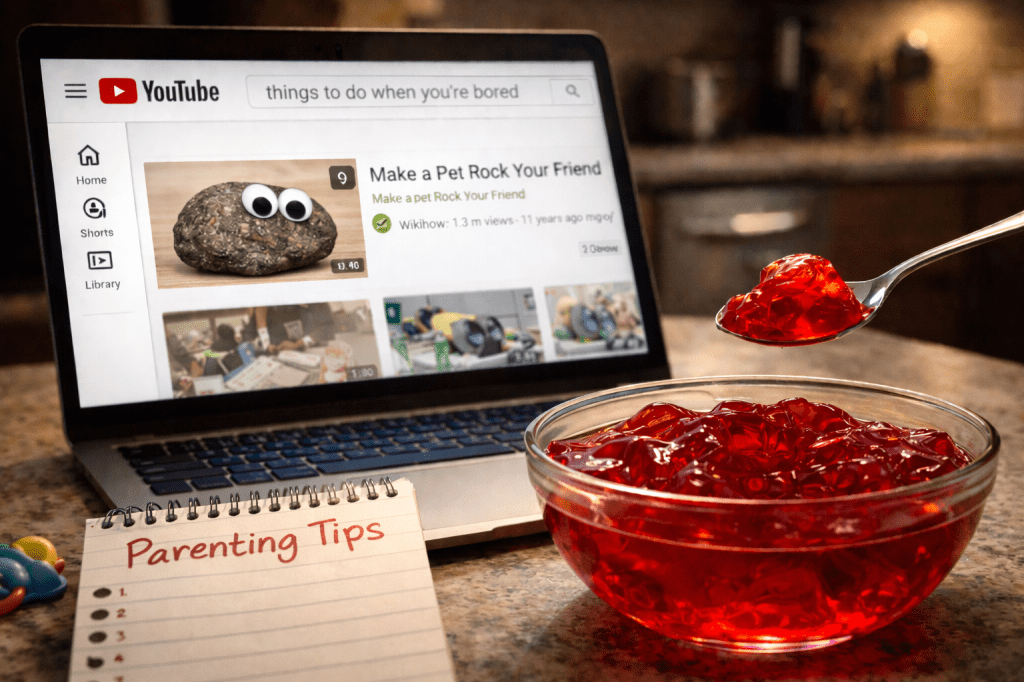
I still remember it, the exact moment I Googled “things to do when you’re bored.”
It’s funny now, looking back, how I somehow became best friends with a search engine throughout my adult life. There was something slightly ridiculous about relying on a robotic oracle to soothe my curiosity or distract me from loneliness.
And like any best friend, it usually showed up around 2am. A glowing rectangle with answers to everything, whispering solutions while the rest of the world slept.
Apparently, that’s when my brain decides it’s time to investigate life’s most pressing historical mysteries. Things like how tall Jesus really was, or who exactly was the first person to milk a cow, and what series of events led to that decision.
But on this particular night, the question I typed into the search bar was far less philosophical.
“Things to do when you’re bored.”
That particular search result? Make a pet rock your friend.
I laughed. The kind that makes you snort a little because no one’s there to judge you. I shook my head, half amused, half comforted. Because underneath the humour was a quiet truth. There has never been a thing I couldn’t learn if I really wanted to.
That self-belief was my bridge into motherhood.
Contrary to the belief that I came from a strong family unit, the dysfunction of my upbringing meant I was my village. Singular. Solo. Alone.
Being estranged from my family for most of my adulthood meant there was no soft landing. No mum beside me showing me how to swaddle a baby, no quiet advice whispered across the couch, no generational wisdom waiting to be passed down.
When I fell pregnant with my son, what I had instead was Wi-Fi and a stubborn determination to figure it out.
In a world where motherhood often feels inherited, I had to build mine from scratch.
Before TikTok hacks and perfectly curated Instagram mums took over our feeds, there was YouTube. Raw, unpolished, abundant. A digital treasure chest of how-to videos that somehow held the keys to everything I needed to survive.
I like to joke now that YouTube became my mother.
She taught me breastfeeding positions, the fine art of burping, how to decode baby cries, and how to change nappies with one hand while praying with the other. She was patient and available at 2am, never judging me for rewinding the same clip ten times because I still didn’t understand what “latching properly” was supposed to look like.
She didn’t sigh. She didn’t tell me I should already know. She just showed me again and again.
Every time I told this story, my Aunt Susan would laugh with that proud sparkle in her eye and say, “You have to write a book one day. It’s too good.”
She told everyone as if it were already folklore. The girl who became a mum through YouTube. And maybe that’s what made me realise it wasn’t just funny, but a story worth telling. Because even without a traditional mother guiding me, I was still being mothered by intention, by women like Susan, and by the version of myself who refused to let lack become limitation.
One of my favourite memories from that chaotic, self-taught season happened on a hot afternoon when I had a pregnant craving for jelly.
The good kind. The wobbly, cold, soul-hugging kind. Red, of course.
I waddled down the hallway to ask my then-boyfriend (which still feels funny to say about my husband) to get me some, and stopped dead in my tracks.
There he was, bolt upright on the edge of the bed, the TV lighting him blue like he’d been caught red-handed.
He slammed pause so fast I genuinely thought I’d interrupted something scandalous.
“What are you doing?” I asked.
“Nothing,” he said.
Too quickly.
Suspicious.
I looked at the screen. A paused video of what looked like a maternity ward and a crying newborn.
And then, as if summoned by the comedy gods themselves, it unpaused.
“Now the second type of newborn cry is the overtired cry…”
We stared at the screen. Then at each other.
“You’re watching baby cry tutorials?”
He covered his face. “I didn’t want you to see it yet. Rikki from work put it on a USB for me. I was trying to learn the different cries. I didn’t want to be useless when he got here.”
And just like that, my jelly craving disappeared.
Because what twenty-four-year-old guy with a perfectly functioning PlayStation and zero pressure secretly studies baby cries on a USB?
He wasn’t just helping.
He was preparing to be a dad.
That USB turned into playlists, and those playlists turned into full-blown labour documentary binges.
Enter One Born Every Minute, our accidental parenting bootcamp.
We had no idea what to expect, but by the end of our impromptu binge education, we walked into that delivery room armed with massage oil, a playlist, and a whole suitcase full of traumatising expectations.
To his credit, my boyfriend didn’t just watch those shows casually. He studied them. From One Born Every Minute, he learned the calming phrases. “You’re doing amazing, babe.”
He learned how to massage my feet between contractions, though I’m still not entirely sure if that was for my benefit or his, because nothing distracted me more from wanting to crush his hand like we were competing in the finals of a world championship thumb war and I was the undefeated hormonal heavyweight.
He even practised breathing techniques with me, inhaling and exhaling beside me like some spiritual doula in training.
But what I remember most clearly is his hand wrapped around mine. Not loosely, but tight like a lifeline. With every contraction, he held on as if his grip alone could pull me through it. I could see it in his eyes.The ache. The helplessness. The fierce love of someone who wished he could take the pain instead.
Tears streamed down his cheeks as he whispered softly, “You’ve got this, babe. I’m so proud of you.”
And I believed him, because I knew that if he could have taken the pain for me, he would have.
He hates it when I tell people he cried during my labour. Not because it isn’t true, but because he’s this big, muscly Pacific Island rugby player with an image to uphold. But behind all that brawn and bravado was the softest, most sensitive soul. The kind of man who didn’t just show up for the moment. He felt every second of it with me.
At one point, during a quiet pause between contractions, a midwife leaned in and whispered something to me.
“He’s the best support partner I’ve ever seen in this ward.”
I could have cried. Actually, I probably did. I was mid-contraction, and everything made me cry. But in that moment, I felt seen, not just as a woman giving birth, but as someone who had chosen well.
Then, after I gave birth, sweaty, stitched, newborn in arms, the hospital brought me a food tray. A sacred offering to the warrior queen who had just pushed life into the world.
They placed it beside me, but I was too busy holding his legacy in my arms.
Eventually, I turned to grab a bite, only to find the tray empty.
“Sorry babe,” he said, rubbing his stomach. “I was starving. Felt like I gave birth too.”
And honestly, I couldn’t even be mad. Because bless him, in his own clueless, wholehearted way, he had laboured with me.
We weren’t traditional. There was no family in the waiting room. No parents pacing the hallway. No familiar voices waiting to celebrate the legacy of his name continuing. Just the two of us learning as we went.
Sometimes the nurses would gently ask when our family might come to visit.
I’d smile and say something polite, because explaining the silence felt heavier than the question. The truth was, not one of our parents ever walked down that hallway. Not even after we had spent almost a week in the hospital recovering from a difficult delivery. Not for the birth of their first grandchild. And not for the second either.
There is something different about the silence that follows disappointment. The moment you realise your family can show up for everyone else at the drop of a hat, with such grandiosity, but not for you or the birth of the next generation.
That kind of absence leaves a quiet ache. Even when it heals over time, it becomes a scar that still hurts to touch. Even now, when we talk about it, we both still get emotional when we see others take for granted the very things we once wished we had.
As the kids grew older, my late-night parenting education simply changed channels. I remember watching Supernanny religiously. That strict but strangely comforting British woman in the black coat and glasses somehow became our accidental potty-training and bedtime guru.
We went from co-sleeping with two little bodies wriggling between us to sleep-training them into their own beds in just under two weeks, all because of her. We followed her instructions step by step like soldiers obeying a bedtime battle plan.
And somehow… it worked.
The kids slept. The house quieted. And slowly, without us really noticing, we grew into the role we had once felt so unprepared for.
My aunt still laughs when we tell the story.
“How did you learn to be such a good mum?” she teases.
And I always answer with a grin, “From YouTube, of course.”
It gets a laugh every time.
Looking back now, I see that the story was never just about late-night YouTube videos. It was about two young parents trying to do something different, trying to build the kind of home we had both quietly needed.
And somewhere along the way, something else was happening too.
Between the sleepless nights and learning motherhood one video at a time, I realised that while I was caring for my children, I was slowly learning how to care for the younger parts of myself.
Over time, the woman who once leaned on Wi-Fi and trial and error began to trust her own instincts. She had proven there was nothing she couldn’t learn if she truly wanted to.
And as that confidence grew, something else began to take shape.
A new kind of family being written into existence.
It was about learning how to give the kind of unconditional love I had never been shown. About creating a family without a blueprint, and discovering that sometimes the most beautiful homes are the ones we build ourselves, even when they aren’t perfect.
Slowly, I began to understand that lack was never a limitation, but proof that cycles can be broken.
And somewhere in the middle of all that, a quiet promise was forming, one I didn’t even realise I was making at the time:
A vow that my children would grow up with the kind of mother I once needed, even if I had to teach myself how to be her.


 The House Of Pine
Leave a comment