Written by Falepaini
“The wound is the place where the light enters you.” – Rumi
We live in a world that worships perfection. Our news feeds and ‘For You’ pages are flooded with polished images and flawless moments. Countless success stories are meticulously crafted to conceal any trace of struggle and pain, while failure and its imperfections are hidden and shunned. This relentless societal pressure to appear perfect and ‘whole’ can often leave us feeling isolated, broken, and unlovable as we struggle to maintain an exhausting façade. But what if real beauty lies in the very cracks we try so hard to hide? What if it’s in the moments when we feel broken and lost that our greatest strength is born?
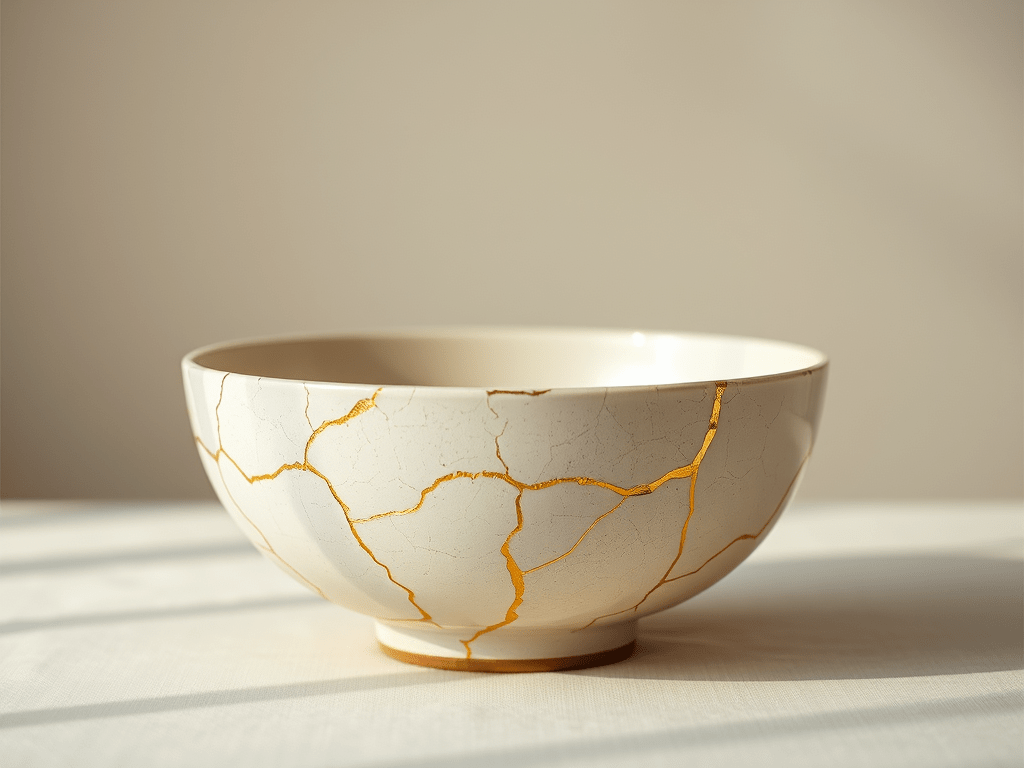
There’s something incredibly humbling about the ancient Japanese art of Kintsugi—the practice of repairing broken pottery with veins of gold. Every fracture tells a story, and every scar etched into the vessel adds to its unique beauty. In those golden lines, I see a reflection of life itself. What once seemed like a painful reminder of what was lost transforms into a testament of resilience and perseverance. Kintsugi whispers an age-old truth we often forget: true beauty is found not in perfection but in our imperfections—and in the strength we discover within them.
I didn’t always embrace this idea. For years, I obsessed over both the flaws I could see and those buried deep within me. I worried that my imperfections defined me, casting a shadow over everything I did. Every crack felt like a burden I had to carry alone, making me feel less worthy and less capable. It’s strange how insecurities become the lens through which we view our entire lives, distorting the truth of who we really are.
There were nights when I cried myself to sleep, convinced that my brokenness made me unlovable. My cracks felt like undeniable proof that I wasn’t worthy of love or acceptance. I often found myself scrolling through social media, watching the highlight reels of other people’s seemingly perfect lives—families gathered at Christmas, enveloped in love and warmth; parents still doting on their adult children, continuing to spoil them on birthdays while proudly supporting and celebrating the milestones of their grandchildren. Such love and care were things I could only dream of well into my adulthood.
It was so easy to feel less than, like I was missing something essential. I longed for that village, the support network I expected from those closest to me as I raised my two children in the quiet confines of my own little family. The absence of that support cut deep, making the weight of holding myself together feel even more crushing.
“Social media hides what Kintsugi reveals—the beauty in brokenness.”
What I had forgotten in those moments was that social media only shows the highlights—the polished fragments of people’s lives. It doesn’t reveal the struggles, scars, or cracks hidden beneath the surface, which are just as much a part of the story. Social media hides what Kintsugi reveals—the beauty in brokenness. Where polished posts gloss over imperfections, Kintsugi highlights them, turning cracks into shining symbols of resilience.
A unique kind of hurt comes from being shattered and having no one to lean on—no one who understands you to your core, who can hold you as you try to put yourself back together. I felt like both the broken pieces and the one trying to mend them while teaching myself how to give my kids the love and support I longed for. But looking back now, I see that even amid that pain, I was stronger than I ever realised. Piece by piece, I held myself together, even without the village I so deeply craved. And though the cracks are still there, they no longer symbolise defeat, failure, or unworthiness.
“It arrived at a time when I had nothing left to hold onto, and the fragmented pieces of myself felt too sharp to bear.”
That profound shift, deep within my heart and mind, was what the ancient Greeks referred to as metanoia—a transformative change of perspective. That realisation felt like a tidal wave crashing over me, sweeping away everything I thought I knew. It arrived at a time when I had nothing left to hold onto, and the fragmented pieces of myself felt too sharp to bear.
This is when Kintsugi became a powerful metaphor for how I viewed life. It reflected my journey, transforming my once-hidden imperfections into symbols of strength, allowing light to shine through where I once saw only scars. As Rumi so beautifully said, “The wound is the place where the light enters you.”
We all carry our own cracks—moments when life unexpectedly breaks us. But what Kintsugi teaches us is that those cracks are not something to be ashamed of. They are the very spaces with the most potential for growth, healing, and transformation.
We are not meant to be flawless, mass-produced copies lined up like dinnerware sets on a shelf. Our value comes from our individuality, the unique stories etched into our scars, and the gold that binds us together. The moments when we feel broken are not the end of our story—they are the beginning of something new.
“You are a one-of-a-kind work of art, crafted through your life’s experiences. Each crack is a reminder of what you’ve survived and how far you’ve come.”
You are a one-of-a-kind work of art, crafted through your life’s experiences. Each crack is a reminder of what you’ve survived and how far you’ve come. After all, even a fractured vessel held together with gold can still pour into others. It doesn’t have to be perfect to be useful or valuable. And neither do we.
Perhaps take a moment today to reflect on a part of yourself you’ve hidden away or considered a flaw. What if that very flaw isn’t a symbol of your brokenness but of your resilience? Maybe, just maybe, that sharp fragment you hold is the missing piece of wisdom someone else seeks.
Let your scratches, dents, and cracks narrate the story of your inner strength and unique beauty, proudly polished as your own highlight. May your cup continue to pour into others, even in its beautifully imperfect and fragmented form. Imagine your vessel reflecting the art of Kintsugi, where the golden seams that hold you together allow your light to shine through. And last but not least, remember your scars: they don’t make you less—they make you more. More beautiful, not despite the broken moments, but because of them. They are your golden veins, intertwining your resilience, your growth, and—just like mine—your unbreakable spirit.
xx





 The House Of Pine
Leave a reply to David Cancel reply